Best of the Red Sea: Daedalus–Rocky Island–Zabargad-St. Johns-Elphinstone

Best of the Red Sea: Daedalus–Rocky Island–Zabargad-St. Johns-Elphinstone

Itinerary Highlights

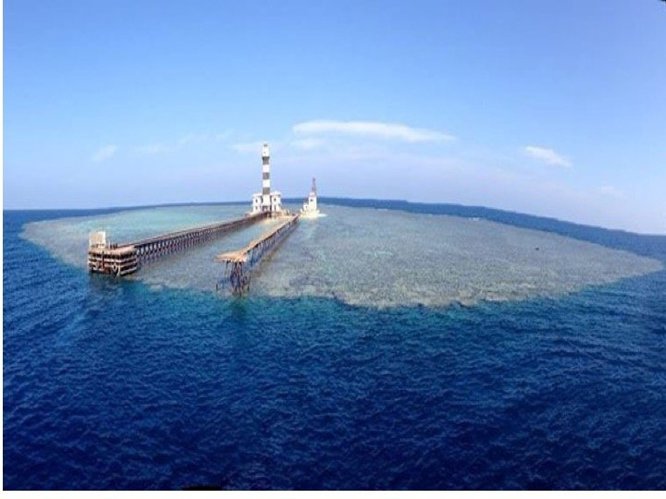
  • The Daedalus reef is a huge reef formation that lies at about 180 km south of Brother Islands.
  • The reef is surrounded by a sheer wall all around, featuring a plateau on its southern side that goes from 28 m beside the reef to 40m on the edge of the drop off. If the weather is good, try to get as far north as possible and drift along one of the sides of the reef. Reef and hammerhead sharks are often spotted here. Marine life is here more abundant than anywhere else, with schools of surgeons, fusiliers.
  • Rocky Island is a mystical site that represents a diver’s dream. The indented reef that circles the entire perimeter of the island drops deeply to an astonished depth and the constant currents that flow all along the year favor the growth of different kinds of colorful marine life in a continuous struggle for a place on the reef. The walls are absolutely covered with the most beautiful soft corals, as well as gorgonias, fans, sponges and black coral trees.. Reef sharks, especially grey and silver tips, you can watch in the blue and may be manta rays, turtles and dolphins.
  • The Island of Zabargad is a superb dive spot. Here you can dive along walls, hover over drop offs or dive slowly in the shallow area, watching the big amount of reef fishes or inhabitants and admire the beautiful coral garden. In the deep south of the Red Sea we find the St. Johns reefs. Big Habili and Small Habili with their fantastic drop offs overgrown with big gorginias and colorful bright soft corals promise you to be a fantastic dive. You find a lot of marine life at the reef itself and as well in the blue you may see barracudas, different sharks, sometimes dolphins or manta passing by.
  • The Reef of Elphinstone, a truly legendary reef, is one of the most beautiful reefs in the Red Sea, with its north and south plateau, and the walls covered with soft corals, black corals, wire corals and gorgonias. Hammerheads, Oceanic white tip sharks and grey reef sharks can also be spotted here.
  • Daedalus Reef

    Daedalus Reef is surrounded by a steep wall and features a plateau on the south side, which drops from 30 m at the wall to 40 m at the edge. The plateau is covered in colorful vegetation right down to the shallow area; turtles like to hang out there, as well as plenty of schooling fish. A closer look is worthwhile to spot snails, scorpionfish, and stonefish. It's not uncommon for a thresher shark to stop by the plateau. At the northwest tip, there's a good chance of encountering hammerhead sharks, but reef sharks of all kinds can also be observed. Drifting along the west side, you'll come across Anemon City: a colony of anemones has settled about 10 m wide and at a depth of 5 m to 30 m, forming a giant flokati carpet in the current. The fish population is impressive: schools of fusiliers, surgeonfish, and jacks, more diverse and abundant than anywhere else.

  • Elphinstone

    This long finger like reef runs from north to south in the open Red Sea. Steep walls drop to the depths on the reef’s east and west sides, while the north and south ends of the reefs are marked by submerged plateau. Sharks often swim by the spot to feed on the abundant reef fish population.

  • Zabargad

    Zabargad has two shipwrecks to offer, both in the sport diver friendly area. On the east side, between 1 - 24 meters deep, you will find a wreck 70 meters long and about 10 meters wide, the name and history of which have long been the subject of speculation. It is assumed that it is a Russian motor freighter that sought the protection of the island after a collision or explosion on board and sank there - the damage in the stern area would speak for this. The vegetation of the wreck suggests a sinking period in the 1950s to -60s. On the southeast side, there are many cave passages in the upper reef area where, if you are lucky, you can find nudibranchs and turbellaria. On the west side of Zabargad, besides beautiful hard coral gardens, you can dive the remains of the safari ship "Neptuna", which sank here in 1981. On the sandy bottom at a depth of 24 meters you can find evidence of the sinking: a generator, several suitcases, a radar unit and a diving tank. However, there is no trace of the wreck of the ship. Since the reef is only slowly steepening at this point, the safari boat cannot have slipped any further into the depths, so it must be lying somewhere nearby. Presumably, at that time, when the stern was already submerged, it drifted a little further, while the mentioned objects fell overboard. The wreck of the "Neptuna" could not be located until today and thus remains one of those mysteries with which the Red Sea can still come up with. Safari boats usually seek shelter to anchor on the south side of the island - behind a large lagoon. Around the lagoon, which is about 10-12 meters deep, it descends steeply to depths of over 50 meters. You can reach the inside of the lagoon through numerous passages through the rock that rises around the lagoon and is lush with colorful soft corals.

  • Rocky Island

    The island has an extension of 300m by 80m and has a fringing reef all around. The south side of the reef consists of overhangs and half caves where very often white tip reef sharks sleep. Even more, the east and west are real Shark Points, because here the sharks are in a current that comes from the north and also brings in huge schools of sardines and their predator, the tunas. The north, on the other hand, is a deeply indented steep wall with ledges and overhangs. Here one sometimes encounters dolphins. Around Rocky Island again marine park rules apply and due to various currents it is a very challenging reef.

  • Shaab Maksur

    It is 350 to 400m long and has three plateaus, one of them - untypical for an outer reef - on the west side. The currents are similar to Elphinstone, as both reefs have almost exactly the same orientation. The south plateau actually consists of two levels. The first ranges from 18 to 35m, the second from 35 to 42m. Both have a length of 50 to 60m and a width of 40m. At the end, the reef descends steeply to 80m, then continues into a slope to 120m before disappearing fully into the depths. The west side has something special, because bordered by a coral garden and a block at the end there is a small lagoon in the middle of the plateau, which is very nicely embedded with a depth of 13-16m and a width of 20m. Here lie some pieces from an old safari boat that hit the reef after 14 days in service. The riggings were thrown overboard and the hull was taken to the shipyard for reconstruction. Meanwhile the reef has grown very nicely around the wreckage. The eastern area is a drop off and to the north there is another plateau at a depth of 20 to 37 meters where there are smaller mounds and a coral garden. Here, as everywhere on this reef, downward currents can occur. At the northernmost point there are two more rocky pinnacles separated from the reef by an 8m deep gap.

Golden Dolphin Safari World

English Deutsch 中文(简体)
up